
Mount Kilimanjaro is the image that sells Amboseli, but it is not the experience you should build the trip around. The mountain can disappear behind cloud or haze. A rewarding visit still has to work when the summit never appears.
Amboseli does. Its open grassland, acacia woodland, marshes and swamps create a compact safari with unusually clear visual contrasts. Elephants are central to the park's identity, yet the more complete story is how wildlife uses water in an otherwise dry-looking landscape—and how that concentration changes through the day and seasons.
Amboseli at a glance
- Location
- Southern Kenya near the Tanzanian border, roughly 200–220 km by official road approaches from Nairobi
- Scale
- A compact national park with open views and a navigable game-drive network
- Core experience
- Elephants, plains wildlife, wetlands, birds and landscape photography
- Kilimanjaro
- A striking possibility, never a guaranteed view
- Stay length
- Two nights works well; three suit slower photography, families or lodge time
- Access
- Road via Emali or Namanga approaches, or scheduled/charter air service
- Main trade-off
- Less ecosystem scale and route variety than the Maasai Mara
What Amboseli offers beyond the postcard
The park's openness makes animal movement easier to read than in denser woodland. Elephants may cross dry-looking plains toward permanent marshes; zebra, wildebeest, buffalo and antelope use the same broad visual field; waterbirds shift attention down into the wetlands. Acacia woodland and thorn scrub add habitat variety even when the horizon dominates the photographs.
This is not a vast, endlessly unfolding safari circuit. Amboseli's relatively compact scale is part of its appeal: less time is required to understand the broad geography, and repeat drives can revisit an area under different light or with different wildlife. The same quality can become a limitation on a long stay if every drive follows an identical loop.
Photography works on several levels. Open sightlines help with environmental compositions and moving herds. Dust, rain, green growth and the changing level of seasonal water alter the palette. Kilimanjaro, across the border in Tanzania, can provide extraordinary scale when it is visible—but clouds frequently decide otherwise. Early starts improve the chance of clear air on many days; they do not create a promise.
Experience
Four reasons Amboseli can justify the detour
-
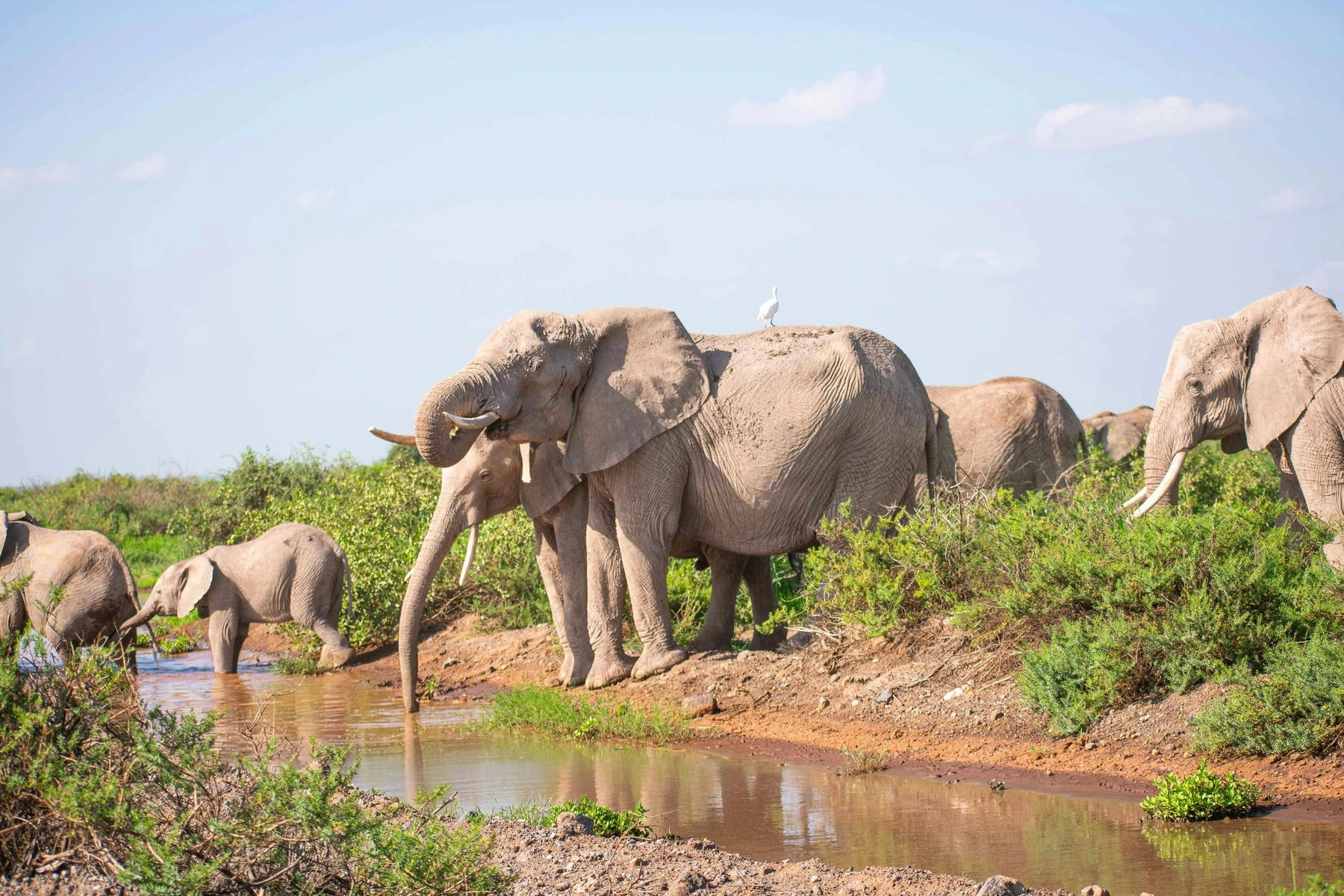
Elephant behaviour in an open landscape
Long-running research has made Amboseli's elephant population especially well documented. Visitors benefit most by watching family movement and behaviour, not by asking a guide to push close.
-
Wetlands in a dry-looking basin
Swamps and marshes support resident wildlife and birdlife even when the surrounding plain looks dusty. They are the ecological counterpoint that makes the park more than open savannah.
-
A manageable safari scale
Two nights can produce meaningful morning and afternoon windows without the long internal distances of a larger ecosystem. This suits a short southern Kenya extension.
-
Landscape-led photography
Big skies, open ground, dust, water and changing light create strong images even when Kilimanjaro stays behind cloud.
Seasonality changes the mood, not the need for uncertainty
Drier periods can draw wildlife toward dependable water and make the open basin feel stark and graphic. Rain can bring greener landscapes, temporary water, bird activity and more difficult sections of road. Neither description should be converted into an exact promise: rainfall patterns vary, and local conditions matter more than a generic month label.
Kilimanjaro visibility is affected by cloud, haze, dust and the time of day. Morning is often the sensible photographic attempt, while afternoon cloud can build, but clear and obscured days occur in every travel season. Plan at least two dawn or early-morning chances if the view matters, then make sure the rest of the park still justifies the visit.
Amboseli and the Mara solve different trip questions
Compact and visual
Amboseli
Stronger when elephants, wetlands, open landscape photography and a southern Kenya route are the priorities. Two nights can feel complete; repeated loops may feel familiar on a much longer stay.
Larger wildlife system
Maasai Mara
Stronger when broad wildlife variety, predator-focused game viewing and several days across reserve or conservancy country lead the trip. It asks for more attention to accommodation geography and crowd strategy.
Combined route
Both parks
Credible when the trip has enough days to absorb the transfer. By road they are not adjacent; routing via Nairobi or using scheduled air links can consume meaningful time and budget.
Is Amboseli worth adding?
Add Amboseli if…
- Elephants and animal behaviour are central interests.
- You enjoy wide landscapes, wetland birdlife and photographic light as much as a species checklist.
- A compact park fits the available time better than another large ecosystem.
- Your Kenya route already uses Nairobi, Tsavo West or the country's southern approaches.
- You can enjoy the park even if Kilimanjaro remains hidden.
Think carefully if…
- The mountain view is the only reason for the detour.
- You expect the same predator density, scale or route variety associated with the Mara.
- Your plan adds long road transfers for only one hurried drive.
- Several full days of repeated game-drive circuits would frustrate you.
- A changing road or rainfall condition would make a fixed same-day connection risky.
How long should you stay?
One night is vulnerable: arrival delays can remove the afternoon drive, cloud can cover the mountain, and departure pressure can shorten the next morning. Two nights protect an arrival window, a full morning-and-afternoon rhythm and a final chance before leaving. That is the practical sweet spot for many routes.
Three nights are not inherently repetitive. They become useful when the plan changes pace: a patient photographic drive, birding, time at an observation point, a lodge break or a responsibly arranged community experience. Three nights feel repetitive when the operator simply repeats the same rushed circuit.
Road access from Nairobi is commonly described as roughly four hours, but the official routes are around 204–220 km before accounting for the traveller's starting point, traffic, stops, gate process and lodge position. Treat four hours as a favourable planning reference, not a protected arrival time. Amboseli can connect onward toward Tsavo West, while a Mara combination needs a deliberate Nairobi or air-routing plan.