
The Maasai Mara is often sold as a single spectacle: wildebeest at a river, predators in pursuit and a vehicle placed perfectly in the foreground. That image is real on some days, but it is a poor way to choose a safari.
The stronger reason to visit is the wider ecosystem. Open grassland, riverine woodland and seasonal water support resident wildlife throughout the year. The reserve also connects with the Serengeti and with community conservancies beyond its boundary. Where you sleep, when you travel and how much driving time you protect will shape the experience as much as the name “Mara.”
The Mara at a glance
- Location
- Southwestern Kenya, adjoining Tanzania's Serengeti ecosystem
- Core experience
- Vehicle-based wildlife viewing across open plains, river country and woodland
- Migration context
- Herd movements are seasonal and rain-led; presence in Kenya and river crossings cannot be fixed to exact dates
- Stay length
- Three nights is a strong first visit; two nights is workable but compressed
- Access
- Road from Nairobi or scheduled light aircraft to several Mara airstrips
- Big decision
- National reserve, Mara Triangle or a community conservancy—and where the camp sits relative to daily drives
- Main trade-off
- Exceptional wildlife potential can coincide with high vehicle density around headline sightings
What makes the Mara feel different
The landscape makes wildlife legible. Long views across grassland can reveal elephants moving between feeding areas, a cheetah using a rise, giraffes crossing the horizon or vultures marking activity well before a vehicle reaches it. Along rivers and drainage lines, woodland changes both the species and the difficulty of finding them. A good drive moves between these habitats rather than treating every hour as a search for the same five animals.
The Mara is also part of a functioning pastoral and conservation landscape. The national reserve is publicly protected land managed in two main sectors: the Narok side and the Mara Triangle. Around it, conservancies are formed through agreements with Maasai landowners and tourism partners. Wildlife moves across these administrative lines; visitors do not move across them without the right access arrangements.
That scale creates choice. A reserve-based stay can provide direct access to public game-drive areas and migration-season river country. A conservancy stay may limit bed or vehicle numbers and offer activities governed by that conservancy, but access rules, exclusivity and reserve-entry costs differ. “In the Maasai Mara” is therefore not a precise accommodation location.
Experience
What earns the Mara its reputation
-
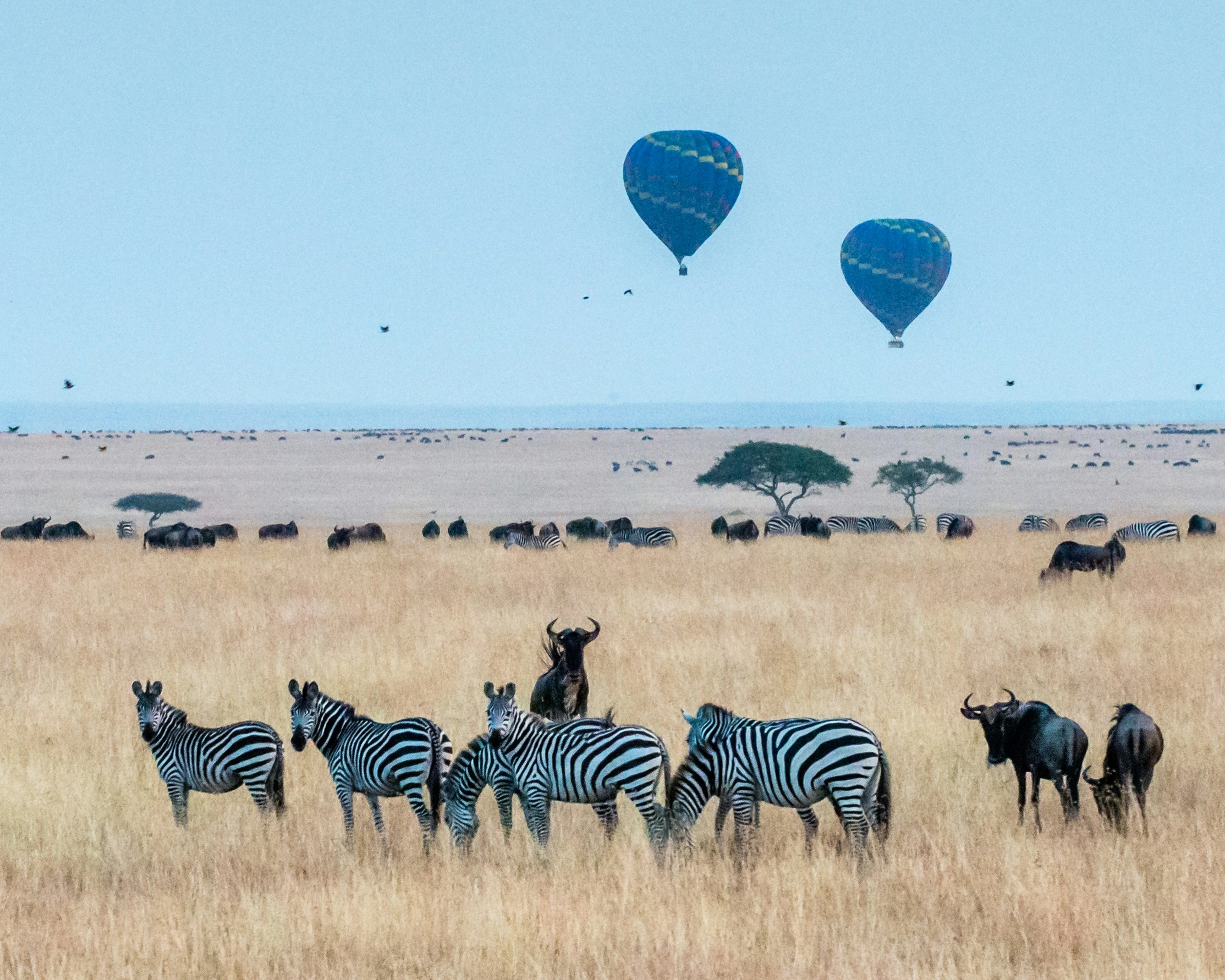
Resident wildlife beyond migration season
Lion, elephant, buffalo, giraffe, zebra, antelope, cheetah, hyena and many other species use the ecosystem year-round. Leopard and black rhino are present but should never be treated as scheduled sightings.
-
Space that rewards patient guiding
Open country supports long observation: following behaviour, waiting for animals to move and reading distant clues. The best drives are not necessarily those with the longest species list.
-
Seasonal change on a continental scale
The Mara forms the northern part of the Serengeti–Mara system. Migratory herds follow grazing and rain, making timing probabilistic rather than a calendar appointment.
-
Meaningful accommodation geography
Reserve, Triangle, conservancy and boundary-area camps can all work. Each changes transfer time, entry payments, activity rules and the areas realistically reached at dawn.
Migration season is a window, not an appointment
Large wildebeest and zebra herds commonly move into the wider Mara ecosystem during the middle and later part of the year, but rain and grazing determine their progress. They do not arrive together on a published date, remain evenly spread, or cross a particular river because visitors are waiting. Some years bring earlier or later movements, pauses and returns.
A river crossing is especially unpredictable. Herds may gather and turn away; a crossing may happen elsewhere; the event may occur before your vehicle arrives. Build a migration-season trip around several rewarding game drives, not a single demanded scene. Outside the main migration window, the plains do not become empty. Resident wildlife and fewer vehicles can make other months a better fit for travellers who value space over peak-season drama.
Reserve or conservancy—and which side?
The national reserve and adjoining conservancies are connected ecologically but operate differently. Public reserve areas can become busy around cats and crossings, particularly in peak periods. The Mara Triangle publishes rules that restrict time at crowded sightings when several vehicles are waiting. Conservancies commonly control tourism through their own bed, vehicle and partner arrangements; some promote lower vehicle density and may permit activities not offered on ordinary reserve game drives.
Neither model is automatically better. A conservancy camp can be quiet yet poorly placed for a specific reserve goal. A reserve lodge can remove a gate transfer yet sit far from the area you hope to explore. Some camps outside a boundary require daily entry and transit before wildlife viewing begins. Ask for a map, the exact camp, the game-drive rights included and the expected transfer to the relevant gate or airstrip.
Choose the Mara experience, not just the destination name
Direct public access
National reserve or Mara Triangle
Best when reserve game-drive access and particular river or plain areas are priorities. Expect public rules and the possibility of many vehicles at prominent sightings in busy periods.
Managed visitor numbers
Community conservancy
Often attractive for a quieter rhythm, landowner-linked conservation and conservancy-specific activities. Confirm whether reserve drives are included and how entry fees and transfer time work.
The hidden variable
Outside the boundary
A good-value camp may still be a good choice, but daily gate travel can consume the best light. “Near the Mara” does not tell you how the safari will operate.
Who the Mara suits
Choose the Mara if…
- You want a wildlife-led safari with strong guiding potential and varied resident species.
- Open landscapes, predators and time observing behaviour matter more than ticking off activities.
- You can give the area at least two nights, preferably three or more.
- You are willing to choose a camp by location and access rights rather than by photographs alone.
- You accept that migration and individual sightings remain wild and uncertain.
Consider another plan if…
- Your trip depends on a guaranteed river crossing or a guaranteed Big Five list.
- You dislike vehicle clusters but plan to visit peak areas at peak times without considering a conservancy.
- You have only one usable game-drive window after a long road transfer.
- A lower-intensity, smaller-scale park would fit your energy or budget better.
- You want every activity—walking, night drives or off-road viewing—without checking where it is permitted.
How long makes sense?
Two nights usually create an arrival drive, one substantial day and a departure window. It can work by air or with disciplined road timing, but small delays have a large effect. Three nights give a second full safari rhythm and make it easier to explore beyond the nearest cluster of vehicles. Four nights or a split between reserve and conservancy can suit photographers, migration-focused travellers and anyone who wants patient observation rather than continual movement.
Road and air are not equivalent versions of the same three days. Driving from Nairobi can take much of day one and day three once city traffic, stops, road conditions, gate formalities and the final track to camp are included. A scheduled light aircraft protects safari time but adds baggage limits, airstrip transfers and a higher cost. It can also involve intermediate stops. Compare door-to-door plans, not a headline driving or flight duration.